


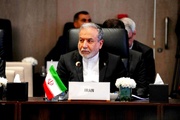
Iran’s Foreign Minister Seyed Abbas Araghchi, speaking at the 17th Al Jazeera Forum on “The Palestinian Issue and Regional Balance in a Multipolar World,” emphasized that Palestine is not merely a regional or humanitarian concern, but a cornerstone of sustainable security in West Asia and a test of the international community’s adherence to international law.
Araghchi described the ongoing situation in Gaza as beyond a conventional military conflict, highlighting mass killings of civilians and the destruction of critical infrastructure as violations of international law constituting genocide.
He warned that Israel’s continued immunity from accountability undermines global legal norms and risks replacing the rule of law with brute force, creating serious threats to peace and stability that extend beyond Palestine.
Here is the full text of his speech:
Excellencies,
Distinguished colleagues,
Ladies and gentlemen,
السلام علیکم
It is a privilege to address you at this distinguished forum and discuss the profound question of our region: PALESTINE.
Let me begin with a fact that the region has learned through decades of painful experience, and that the world is learning again at a terrible human cost:
“Palestine is not one issue among many”.
Palestine is the defining question of justice in West Asia and beyond. It is the strategic and moral compass of our region. It is a test of whether international law has meaning, whether human rights have universal value, and whether global institutions exist to protect the weak—or merely to rationalize the power of the strong.
For generations, the Palestinian crisis was understood primarily as the consequence of an illegal occupation and the denial of an inalienable right: the right of a people to self-determination. But today, we must recognize that the crisis has moved far beyond the parameters of occupation alone. What we are witnessing in Gaza is not merely war. It is not a “conflict” between equal parties. It is not an unfortunate byproduct of security measures. It is the deliberate destruction of civilian life on a massive scale. It is genocide.
The human cost of Israel’s atrocities in Gaza has wounded the conscience of humanity. It has torn open the heart of the Muslim world—and it has also shaken millions beyond it: Christians, Jews, and people of all faiths, who still believe that the life of a child is not a bargaining chip, that starvation is not a weapon, that hospitals are not battlefields, and that the killing of families is not self-defense.
Palestine today is not simply a tragedy; it is a mirror held up to the world. It reflects not only the suffering of Palestinians, but also the moral failure of those who had the power to stop this catastrophe—and chose instead to justify it, enable it, or normalize it.
But Palestine and Gaza is not only a humanitarian crisis. It has become the platform for something larger and more dangerous: an expansionist project pursued under the banner of “security.”
This project has three consequences—each of them profound, each of them alarming:
The first consequence is global. The Israeli regime’s conduct in Palestine, and the impunity granted to it, have deeply damaged the international legal order. We must say this clearly: the world is moving toward a condition where international law no longer is respected and governs international relations.
What is perhaps most dangerous is the precedent being established: that if a state has sufficient political cover and protection, it may bomb civilians, besiege populations, target infrastructure, assassinate individuals across borders, and still demand to be regarded as lawful.
This is not merely a Palestinian problem. It is a global problem.
We are witnessing not only the tragedy of Palestine, but the transformation of the world into a place where the law is replaced by force.
The second consequence is regional. Israel’s expansionist project has had a direct and destabilizing impact on the security of all countries in the region.
The Israeli regime now openly violates borders. It breaches sovereignties. It assassinates official dignitaries. It conducts terrorist operations. It expands its reach in multiple theaters. And it does so, not discreetly, but with a sense of entitlement—because it has learned that international accountability will not come.
Let us be candid: if the Gaza issue is “settled” through destruction and forced displacement—if that becomes the model—then the West Bank will be next. Annexation will become policy.
This is the essence of what has long been called the “Greater Israel” project.
The question therefore is not whether Israel’s actions threaten Palestinians alone. The question is whether the region will accept a future in which borders are temporary, sovereignty is conditional, and security is determined not by law or diplomacy, but by the ambitions of a militarized occupier.
The third consequence is structural—and perhaps the most dangerous.
Israel’s expansionist project requires that neighboring countries be weakened—militarily, technologically, economically, and socially—so that the Israeli regime permanently enjoys the upper hand.
Under this project, Israel is free to expand its military arsenal without limits, including weapons of mass destruction that remain outside any inspection regime. Yet other countries are demanded to disarm. Others are pressured to reduce defensive capacity. Others are punished for scientific progress. Others are sanctioned for building resilience.
Nobody should be confused: This is not arms control. It is not non-proliferation. It is not security.
It is the enforcement of permanent inequality: Israel must have a “military, intelligence and strategic edge,” and others must remain vulnerable. This is a doctrine of domination.
Ladies and gentlemen,
This is why the Palestinian question is not only a humanitarian issue. It is a strategic issue. It is not only about Gaza and the West Bank. It is about the future of our region and the rules of the world.
So what must be done?
It is not enough to express concern. It is not enough to issue statements. It is not enough to mourn. We need a coordinated strategy of action—legal, diplomatic, economic, and security-based—rooted in the principles of international law and collective responsibility.
First, the international community must support legal mechanisms without hesitation.
Second, there must be consequences for violations.
We call for comprehensive and targeted sanctions against Israel, including:
- an immediate arms embargo
- the suspension of military and intelligence cooperation
- restrictions on officials
AND,
- banning trade
Third, we need a credible political horizon grounded in law. The international community must affirm:
- the end of occupation
- the right of return and compensation in accordance with international law
AND,
- the establishment of a unified and independent Palestinian state with Al-Quds Al-Sharif as its capital
Fourth, the humanitarian crisis must be treated as a matter of urgent international responsibility. Collective punishment must never be normalized.
Fifth, regional states must coordinate to protect sovereignty and deter aggression. The principle must be clear: security cannot be built on the insecurity of others.
AND,
Finally, the Islamic world, the Arab world, and the nations of the Global South must build a united diplomatic front.
The Organization of Islamic Cooperation, the Arab League, and regional organizations must move beyond symbolism toward coordinated action: legal support, diplomatic initiatives, economic measures, and strategic messaging.
This is not about confrontation. It is about preventing the region from being reshaped by force.
Dear colleagues,
Let no one miscalculate: a region cannot be kept stable by allowing one actor to act above the law. The doctrine of impunity will not produce peace; it will produce wider conflict.
The path to stability is clear: justice for Palestine, accountability for crimes, an end to occupation and apartheid, and a regional order built on sovereignty, equality, and cooperation.
If the world wants peace, it must stop rewarding aggression.
If the world wants stability, it must stop enabling expansionism.
If the world believes in international law, it must enforce it—consistently and without double standards.
And if the nations of this region seek a future free from perpetual war, they must recognize this fundamental truth:
Palestine is not merely a cause for solidarity; it is the indispensable cornerstone of regional security.
Thank you.
MNA





Your Comment